The Actor-Director Model: How AI is Rewriting Game Development
Your game’s art is stuck. A character model needs another round of changes. A weapon doesn’t feel right. The environment looks empty. This is the old pipeline at work. Design, model, texture, animate, implement. It’s a slow relay race where the 3D file is a baton that gets dropped too often.
That system is broken. It was built for scarcity. It is assumed that creating a single asset is a slow, specialized task. But what happens when creation is instant? When you can generate a production-ready model in the time it takes to describe it?
This isn’t about doing old things faster. It’s about doing new things. We are moving from a slow production line to a dynamic creative studio. From managing tasks to directing a performance. This is the shift to an AI-native workflow. Neural4D is at the center of this change. It enables a new way of working: the actor-director model.
The Linear Pipeline Has Hit a Wall
The old way works in a straight line. A concept goes to a modeler, then to a texture artist, then to a rigger. Each step is a bottleneck. Feedback takes days or weeks. This process creates two big problems.
First, it kills agility. You cannot test art styles quickly. You cannot respond to player feedback in real time. Your creative choices are locked in months before anyone sees them.
Second, it wastes human talent. Skilled artists spend their energy on technical tasks. Topology, UV mapping, routine work. Their real value is their taste, style, and vision. The old system buries that.
This pipeline is optimized for constraints that no longer exist. The limit today isn’t our ability to make an asset. It’s our ability to decide which asset to make, and why.
The New Stage: Directors and Digital Actors
Think of a film set, not a factory floor. This is the actor-director model.
In this model, the human team is the directors. The game director, art director, and lead designer. Their role changes. They are no longer managers of a task queue. They are curators of a world. They define the vision: the tone, the story, the aesthetic rules. Their main job becomes creative direction.
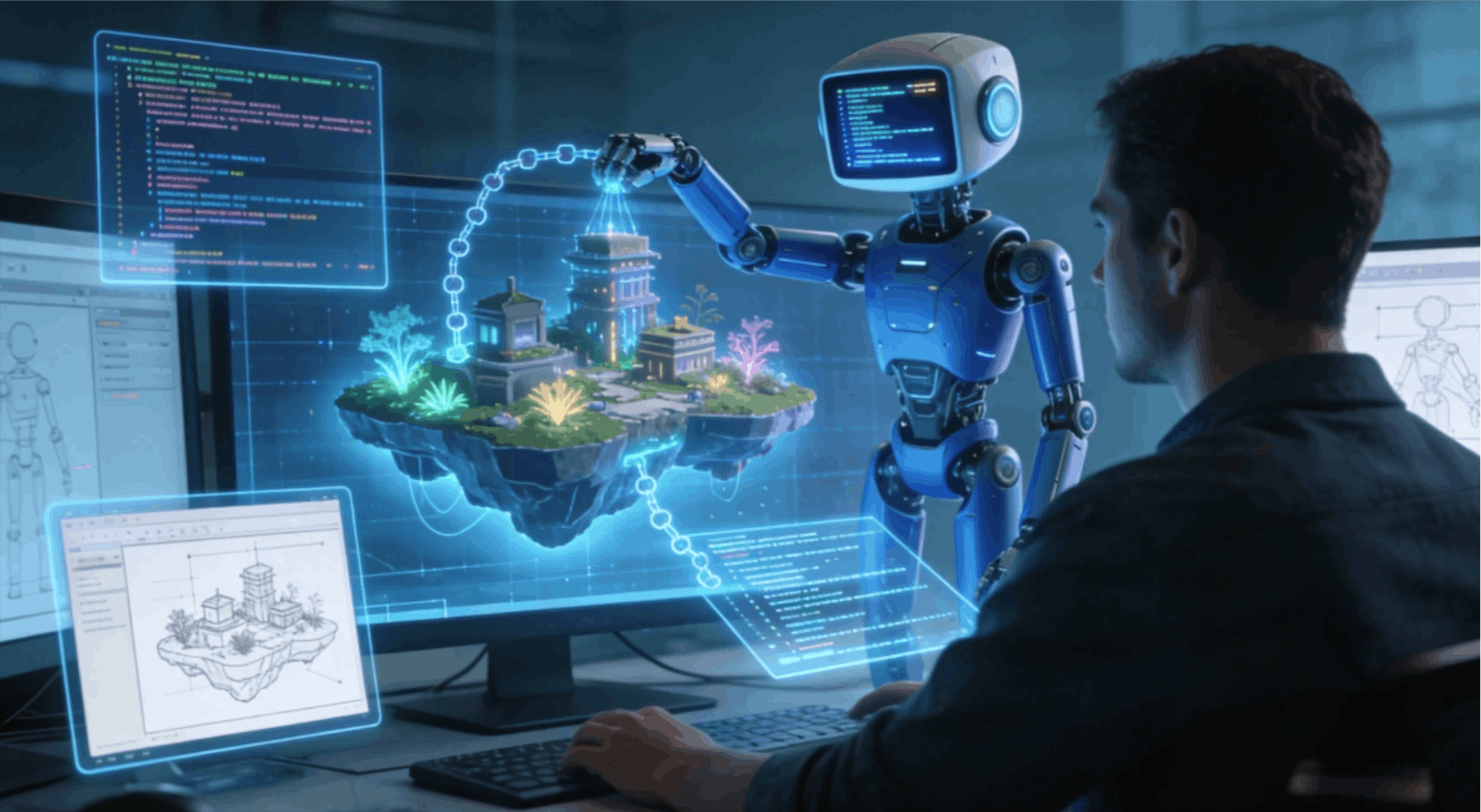
The AI systems, like Neural4D, become the digital actors. You don’t just operate these tools. You direct them. You provide the motivation, the backstory. “This character is a tired mercenary. Pragmatic. His armor is cobbled together from old machines.” The AI interprets this direction and performs. It generates not just a shape, but a persona.
The collaboration is live. A director reviews the output. They give a note: “More weary. Less shiny. Add a meaningful scar.” The AI actor adjusts its performance in seconds. The iteration cycle collapses from weeks to minutes. This isn’t revision. This is a rehearsal.
The Remade Team: New Roles, New Skills
This shift doesn’t erase jobs. It redefines them. It creates new specialties and raises the value of core human skills.
The Creative Director as AI Trainer
The most valuable skill for an art lead is no longer just a good eye. It’s the ability to articulate intent to an AI. This is part linguist, part curator. You need clear, evocative language. You need the taste to pick the best option from a dozen AI-generated versions. You need the patience to guide the next iteration. You’re not pushing polygons. You’re shaping a creative process.
The Rise of the AI Technical Artist
This is a new key role. This person understands art and the technology that creates it. They won’t just use Neural4D’s API. They’ll fine-tune it on the studio’s style guide. They’ll build tools that let designers generate props inside the game editor. They create systems for dynamically assembling character gear. They are the stage managers for your digital actors.
The Systems Designer’s New Canvas
Designers stop designing only the what. They start designing the how of creation. Instead of placing every tree in a forest, they design the rules for the biome. Altitude, density, species mix. Then they let the AI generate the endless variations. They design the loot system, and the AI generates the thousand unique swords. Their canvas becomes the system of creation itself.
The Technology That Makes the Stage Possible
A chaotic film set produces nothing. This model needs robust, predictable technology. Not tools that generate random surprises, but partners that execute a vision.
This requires systems with three key traits:
- Deep Context Understanding: The AI must follow a complex creative thread. This is what enables Neural4D-2.5’s conversational editing. It doesn’t just hear “add a scar.” It understands the scar should fit the character’s story.
- Structural Intelligence: Digital actors must understand the “anatomy” of game assets. Neural4D’s approach generates models with pre-built skeletons and separable parts. This means the AI knows not just form, but function. It knows what a “sword” is and how an “arm” moves.
- Pipeline Infrastructure: The performance must be integrated. APIs must be as reliable as electricity. They allow these digital actors to perform on cue, live, inside the game engine. This turns generation from a pre-production step into a real-time game feature.
Building Your AI-Native Studio: Start Now
This isn’t a theory for the future. You can start building this now.
- Run a Rehearsal: Pick a low-stakes project. A game jam, or a piece of marketing art. Require the team to use a directing tool like Neural4D. Force the practice of writing prompts and iterating. Measure the time saved. More importantly, watch how the team’s conversation shifts from technical details to creative intent.
- Hire for Hybrids: Look for your first AI Technical Artist. This person will build your stage. Prioritize curiosity and core skills over pre-existing AI expertise.
- Shift the Budget: Start moving software license money into AI operational budgets. Your new production cost isn’t another software seat. It’s the computing power for your digital actors.
- Design for Generation: In your next design meeting, ask a new question: “Could this be parameterized? Could an AI generate interesting variations?” Start planting the seeds for systems that are born AI-ready.
The Final Cut
The goal has always been to create compelling worlds. For too long, the hard work of construction buried that goal. We spent our time making bricks when we wanted to design cathedrals.
The actor-director model changes that. It separates the act of imagination from the act of building. It asks humans to do what only they can do: conceive, judge, feel, and lead. It asks AI, like Neural4D, to do what it now does best: execute, vary, and iterate at incredible speed.
This isn’t about replacing your team. It’s about finally giving them the right stage. The teams that embrace this shift won’t just work faster. They will dream bigger.
The age of the pipeline is over. Welcome to the age of the director.