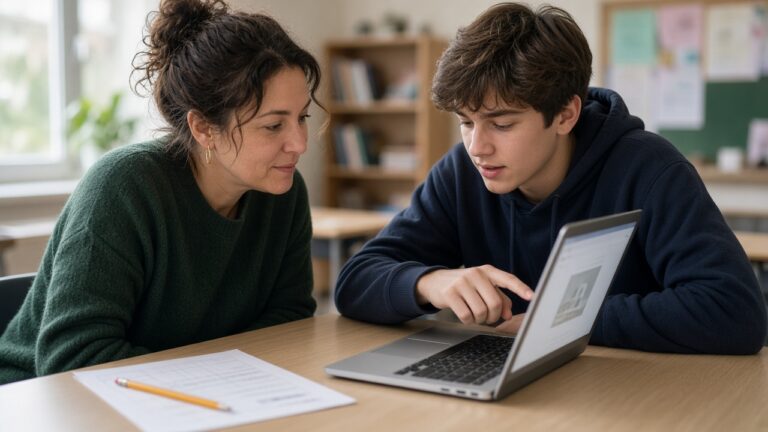
What happens when a teenager gets stuck on a hard maths problem and the help on offer is a person, an artificial intelligence (AI) tutor or a search engine? A new experiment from the University of Cambridge put that AI tutor vs human tutor question to sixth formers in England, and the answer is more interesting than “the robot lost”. Students with a human tutor found the problems easier and attempted more of them. Students with the AI tutor worked hardest of all, yet felt the work was harder. Students left alone with a search engine were the most stressed.
The short version: in a randomised experiment with 149 students aged 16 to 18, a human tutor gave the most supportive experience of difficulty. The AI tutor kept students working and was calmer than searching the web, but it did not make the struggle feel manageable in the way a person did. The researchers did not measure learning, so treat this as evidence about how students cope with challenge, not about grades.
What the Cambridge experiment did
The study, by Megan Ennion and Ros McLellan of the Faculty of Education at Cambridge, was published in the British Journal of Educational Technology on 13 November 2026 and is open access. An accepted version is in the Cambridge repository.
It took place in a large sixth form college of around 3,000 students that already had experience of custom-built AI tutors. A total of 160 students volunteered and 149 gave usable data. Each student was randomly given one form of help for a single 90-minute session:
- a human maths tutor, sitting in the room, who offered guidance when asked but never gave final answers
- Khanmigo Lite, the Khan Academy “Tutor Me” tool, which is designed to guide with questions and hints rather than hand over solutions
- the DuckDuckGo search engine, with its AI features switched off, and any public website the student wanted
Everyone tackled the same two 20-minute sections of four problems each. The college’s heads of mathematics and psychology confirmed the problems went beyond the A-level curriculum, so nobody could coast. All were told to use their support for guidance, not answers. Afterwards they chose six more problems from tiers of difficulty, which gave a measure of how much challenge they were willing to take on.
AI tutor vs human tutor: what the students reported
The human tutor group reported the lowest perceived difficulty in both sections. They also made the most attempts at questions in both sections. In the second section, when students had to go back into hard work after a bruising first round, the gap widened. Students with the AI tutor rated the work as significantly harder than students with a person, and reported significantly more effort.
The human group also showed the biggest drop in perceived difficulty between the two sections, from an average of 2.06 to 1.67 on a five-point scale.
The stress figures are striking, although the authors report them descriptively and did not test them statistically. With a human tutor, 55.8% of students said they felt calm and 5.8% felt stressed. With the AI tutor, 51.9% felt calm and 19.2% stressed. With internet search, only 22.0% felt calm, and 32.0% were stressed.
So the AI tutor sat in the middle. It was far gentler than the open web, and the authors see value in that for independent practice. But it did not do what the person in the room did.
Higher effort is not automatically good news
It is tempting to read “more effort” as a win for the AI tutor. The authors are rightly careful. Higher effort can mean a student is persisting. It can also mean the difficulty never got resolved and they were simply pushing harder against a wall. Lower effort in the human tutor group may mean the tutor made the task feel manageable, not that students switched off. Effort only makes sense alongside difficulty and attempts, and that combined picture favours the human tutor.
The AI tutor kept students working on hard problems. The human tutor made those problems feel possible. In a classroom, that difference matters.
Challenge-seeking did not move
One result surprised me. The type of support made no difference to how much challenge students chose afterwards. What predicted it was their existing tendency to seek challenge, measured before the task. One session with a great tutor, human or not, did not turn cautious students into bold ones. Anyone who has tried to build resilience in a Year 12 class will recognise that. Habits around difficulty are built over months.
What this study does not tell us
The authors are clear about the limits. They did not measure whether answers were correct or whether anyone learned more. It was one session, in one high-attaining and digitally confident college, with volunteers who mostly studied maths and science. All the human tutoring came from a single tutor, whose personal style may have mattered. The AI tutor was Khanmigo Lite as it worked between November 2024 and July 2025, and the authors warn against stretching the findings to every AI tutor. The results also did not support their preregistered hypothesis, so they treat the detailed findings as exploratory.
It fits a wider pattern. In November, Stanford University’s AI Hub for Education updated its review of the causal evidence on AI in schools, now covering 52 studies. It found that students often report better learning experiences with AI that do not translate into better outcomes, and that AI is more likely to help when students use it to understand material than to produce work. The same review lists a study in five schools in the United Kingdom where an AI tutor supervised by expert human tutors did at least as well as human tutors alone. The best results keep appearing where a person stays involved.
If you read our piece on AI tutoring, you will remember that the largest trial so far found pupils rarely asked their AI tutor for help, even when they had made a mistake. This study adds that even when students do use the tutor, being stuck with it is not the same as being stuck next to a teacher.
What I would do with this in school
None of this says ban AI tutors. It says the choice of support is a teaching decision, which is exactly how the authors put it. Here is how I would use the findings.
Put the people where the struggle is hardest
If an AI tutor can carry routine independent practice, use the freed-up time to have teachers or tutors present for the hardest moments. In a sixth form maths department, that might mean the AI tutor supports the practice questions on integration by parts, while the teacher runs a drop-in on the problem sheet everyone finds brutal.
Check whether the difficulty was resolved
An AI tutor can keep a student busy without getting them unstuck. So ask. A simple exit question works: “Which problem were you still stuck on when you stopped?” If the same names and the same topics keep appearing after AI-supported homework, that is your cue to step in.
Teach help-seeking directly
The authors suggest teaching students how to ask for help, including how to use an AI tutor to work through difficulty rather than bypass it. Show a class a weak exchange, where a student types “just tell me the answer”, next to a strong one, where they explain what they tried and where it broke down. This links neatly with our article on how pupils use AI, which found that purpose mattered far more than frequency.
Never leave students alone with the open web on hard tasks
The internet group fared worst on stress, calm and attempts. If you set challenging independent work, give students a structured route for getting unstuck, such as a worked example, a vetted AI tutor or a named person to email. “Look it up” is not support.
I also think this study is a gentle rebuke to the way many of us judge AI tools. We check whether the finished work improves. Ennion and McLellan looked at how students felt and behaved when the work got hard, which is where so much learning is won or lost. As our piece on cognitive offloading and AI argued, the thinking a tool takes away from students matters as much as the work it produces. That is a better question for any school buying an AI tutor this year.
Frequently asked questions
What did the Cambridge tutoring study find?
Students aged 16 to 18 tackled hard maths with a human tutor, an artificial intelligence (AI) tutor or internet search. The human tutor group found the work easiest and attempted the most questions. The AI tutor group reported the most effort but found the work harder, and the search group was the most stressed.
Did students learn more with a human tutor than with an AI tutor?
The study cannot say. The researchers measured perceived difficulty, effort, number of attempts, stress and challenge-seeking, but not whether answers were correct or whether students learned more. It was also a single 90-minute session in one sixth form college, so the findings are exploratory.
Which AI tutor was used in the study?
Students used Khanmigo Lite, Khan Academy’s Tutor Me tool, which is designed to guide students with questions and hints instead of giving final answers. The authors say the findings apply to that tool as it worked between November 2024 and July 2025, not to every AI tutor.
Should schools use AI tutors for independent practice?
The authors suggest an AI tutor may help students keep working during independent practice and was a calmer option than unguided web searching. They argue it should supplement teaching, with teachers checking whether students’ difficulties were actually resolved and stepping in when they were not.
Where do your students go when they get stuck on hard work outside lessons, and have you seen AI tutors help or hinder them? Share what you have noticed in the comments.