A Class 10 student is asked to solve (x − 2)(x − 3) = 6. She writes x-2=2, so x=4, and x-3=3, so x=6. Neither value works: substitute x=4 into the original equation and the left side equals 2, not 6.
She asks an AI tool what went wrong. Within seconds, a clean solution appears: expand, rearrange to x²-5x=0, factorise, and obtain x=0 or x=5. She copies it into her notebook and moves on.
The notebook now looks right. Whether she understands why her method failed is another question.
A teacher looking at the original attempt might recognize the problem immediately. The student has applied a rule that works when a product equals zero, but not when it equals six. Giving her the correct solution fixes the exercise without necessarily correcting that misconception.
This distinction matters as schools increasingly explore AI tutoring. The question is not simply whether a tool can identify a wrong answer. It is whether it can recognize the kind of mistake a student has made and respond in a way that improves understanding.
The Education Endowment Foundation’s Teacher Feedback to Improve Pupil Learning guidance emphasizes that effective feedback depends on its principles and implementation, not merely how it is delivered. Poorly handled feedback can even hinder progress. That caution applies whether the feedback comes from a teacher or a machine.
One Wrong Answer, Three Different Problems
Quadratic equations, covered in CBSE Class 10 mathematics, provide a useful example of how similar-looking wrong answers can reveal different learning difficulties.
1. A concept gap
The first student has misunderstood the zero-product rule. If ab=0, at least one factor must equal zero. But if ab=6, neither factor is required to equal zero.
The student does not primarily need another factorisation exercise. She needs to understand why zero makes the rule possible.
2. A process error
A second student solves x²+5x+6=0, correctly reaches (x + 2)(x + 3) = 0, and then writes x=2 or x=3.
The method is appropriate, but the signs have been reversed in the final step. Asking the student to substitute either answer into the original equation may be enough to reveal the error. Repeating the entire lesson would add little value.
3. An application gap
A third student is told that the product of two consecutive positive integers is 306. She correctly forms x²+x-306=0 and finds x=17 or x=-18.
Both values satisfy the equation, but the question asks for positive integers. The mathematics is correct; the interpretation is incomplete.
These students have all produced wrong final answers, but they do not need the same instruction.
A Three-Error Framework for AI Feedback
Diagnostic AI feedback is feedback that identifies the likely cause of a student’s mistake and adjusts the next instructional step, rather than simply replacing an incorrect answer with the correct one.
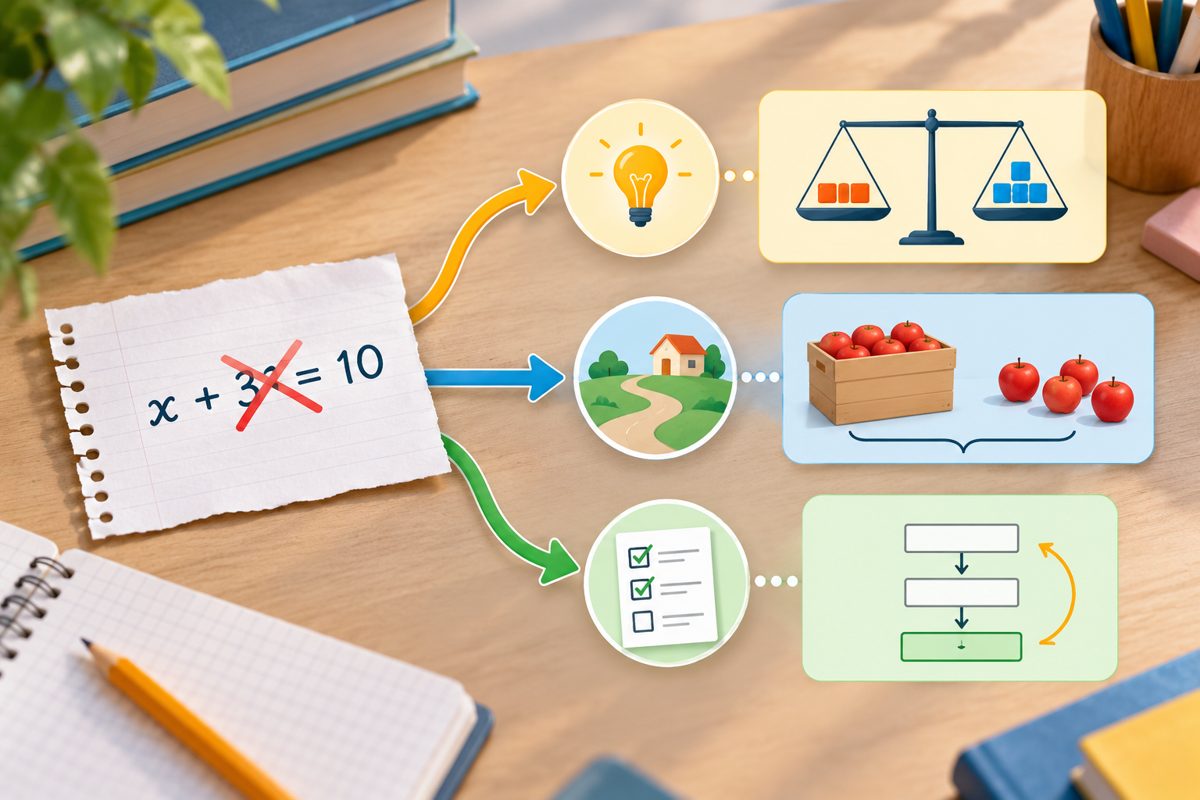
A practical framework distinguishes three error types:
Error type | What it reveals | Appropriate AI response |
|---|---|---|
Concept gap | A misunderstood principle or mathematical relationship | Ask a question that exposes the misconception and explain the underlying rule |
Process error | A correct method with an execution mistake | Direct attention to the specific step and encourage checking |
Application gap | Correct mathematical work without appropriate interpretation | Ask whether the result satisfies the conditions of the problem |
The classification is a starting point, not a diagnosis that should be treated as certain. A student may make several errors at once, and a single written answer rarely reveals everything about their thinking.
The practical rule is simple: teach the principle when the concept is wrong, check the step when the process is wrong, and revisit the context when the application is wrong. The aim is to choose the next useful question, not to label the student.
That is why an effective tutor needs to ask questions before deciding what help to provide.
Diagnose First, Then Help in Small Steps
An experienced teacher often begins with a simple request: "Talk me through what you did here."
An AI tutor can follow a similar approach by offering the smallest useful intervention before moving toward a full explanation.
A practical sequence is:
- Locate the error. Ask the student to check a particular result or step.
- Offer a hint. Point toward the relevant concept without revealing the complete method.
- Explain one step. Clarify the specific point of difficulty, then allow the student to continue.
- Demonstrate a parallel example. Show how the same principle works in a related problem.
- Request an independent attempt. Give the student a fresh question without assistance.
The amount of help should depend on the student’s response. Some students need only a prompt; others require a worked explanation before they can proceed.
The final independent attempt is particularly important.
A 2025 study published in the Proceedings of the National Academy of Sciences, titled Generative AI without guardrails can harm learning: Evidence from high school mathematics, examined how AI assistance affected mathematics learning.
Students using a standard AI chatbot performed better during assisted practice but worse on a subsequent examination without AI. Students using a more carefully designed AI tutor with safeguards did not experience the same decline, although their independent examination performance was not significantly better than that of students without AI assistance.
The study distinguishes successful assisted practice from what students can demonstrate later without AI.
A useful tutoring session should therefore include opportunities to apply feedback and demonstrate understanding without assistance.
What Better AI Feedback Looks Like in Practice
Return to the student who incorrectly solved (x − 2)(x − 3) = 6.
A conventional answer-generating tool might immediately display the correct solution. A diagnostic tutor could instead begin with the student’s reasoning.
Tutor: "You wrote that x=4 is a solution. Can you substitute 4 into the original equation?"
Student: "That gives (4 − 2)(4 − 3) = 2. So it doesn’t equal 6."
Tutor: "Right. You treated the two factors separately. Do you remember when a product allows us to conclude that one factor must be zero?"
Student: "When the product equals zero."
Tutor: "Exactly. What could you do first to make the right-hand side zero?"
The student can now attempt to rearrange the equation, expand the brackets and solve it using the zero-product rule.
The tutor delays the worked solution to test the misconception, then offers more explanation if needed.
If the student remains confused, a clearer explanation or parallel example may be necessary. Withholding help indefinitely is no more useful than supplying every answer immediately.
After the correction, the tutor could offer a related question, such as (x − 3)(x − 4) = 12, and ask the student to solve it independently.
That second attempt provides more meaningful evidence of understanding than the corrected notebook entry alone.
This exchange is an illustrative teaching example, not a transcript of an actual AI tutoring session.
Prompts That Keep the Thinking With the Student
Students often ask AI tools, "Why is this wrong?" and receive a complete explanation before they have examined their own work.
More focused prompts can encourage a different interaction.
"Ask me one question at a time until I find my mistake" encourages diagnosis before explanation.
"Don’t solve the problem yet. Tell me whether my method is appropriate" separates choosing a method from carrying it out correctly.
"Show me a similar example, but let me solve my original question" provides support without immediately replacing the student’s work.
"Give me a new question to attempt without hints" creates an opportunity to check independent understanding.
Teachers can also encourage students to bring their original attempts into the conversation. A final answer alone may not show whether the difficulty came from a misunderstood concept, a calculation slip or an interpretation error.
What a CBSE Classroom Adds
For CBSE students, recognizing the difference between these errors is especially useful in mathematics and science, where later topics frequently depend on earlier concepts.
A student who misunderstands factorisation may struggle with quadratic equations. Another who understands the algebra but overlooks the conditions of a word problem needs a different kind of support.
This is where curriculum-focused personal AI tutoring can complement classroom instruction.
Edzy’s Personal AI Tutor is designed for CBSE students in Classes 6–12, supporting guided explanations, doubt resolution and subject-focused practice. Its Stepzy feature allows students to examine their problem-solving steps and seek guidance on mistakes rather than treating the final answer as the only measure of progress.
That is Edzy’s tutor-first distinction: guided reasoning rather than a finished answer to copy. A mistaken quadratic solution, for example, might reveal a factorisation misconception or merely a sign error. Reviewing intermediate steps can help a tutor decide which question to ask next. This illustrates the intended approach; it is not a claim about a measured Edzy learning outcome.
A tutor should not respond identically to every incorrect answer. A conceptual misunderstanding may require a fresh explanation; a procedural slip may need only a carefully chosen prompt.
The educational value lies in matching the support to the difficulty, not in producing the longest or fastest explanation.
Five Questions Schools Should Ask Before Adopting an AI Tutor
Schools evaluating AI tutoring tools should look beyond how accurately the systems answer questions.
Five questions can help distinguish an answer-generating tool from one designed to support learning:
- Does the tutor examine the student’s original attempt? A useful system should be able to consider how the student approached a problem, not only whether the final answer is correct.
- Can it respond differently to different errors? Conceptual misunderstandings, procedural mistakes and application difficulties should not automatically receive identical explanations.
- Does it provide graduated assistance? Students should have opportunities to respond to hints and questions before receiving a complete worked solution.
- Can students demonstrate understanding independently? A fresh, unaided problem provides stronger evidence than a corrected answer produced with assistance.
- How does the system protect students? Schools should examine privacy practices, age appropriateness, transparency and the role of teachers in overseeing AI-supported learning.
UNESCO’s Guidance for Generative AI in Education and Research emphasizes human-centred implementation, data protection and age-appropriate use. These considerations should form part of any school’s evaluation, alongside instructional quality.
No single feature establishes that an AI tutor improves learning. Schools need to consider how the tool is used, what evidence of progress it provides and whether students become more capable of working without it.
Keep One No-AI Moment
After an AI-assisted session, close the tool and set a related problem.
If the student can solve (x − 3)(x − 4) = 12 independently and explain why the method works, there is evidence that the feedback has helped. If the student repeats the original misconception, further teaching is needed.

Teachers can make this visible by comparing three pieces of work: the first attempt, the feedback received and the independent second attempt.
Comparing the first and second attempts helps teachers see whether feedback changed the reasoning.
The Real Test of AI Feedback
A corrected answer demonstrates completion, but independent work is a stronger test of understanding.
The more important question is what happens next. Can the student explain the original mistake? Can they select an appropriate method for a similar problem? Can they solve it without the tutor?
AI tutoring should make those moments of independent thinking more likely, not replace them.
The best AI tutor is not simply the one that knows the correct answer. It is the one that helps a student understand the mistake well enough to solve the next problem independently.