Ask any primary teacher where their evenings go and lesson planning will be near the top of the list. So when the Education Endowment Foundation (EEF) published a trial of AI lesson planning with Oak National Academy’s assistant, Aila, on 6 October 2026, I read it with real interest. The headline is encouraging. The detail underneath is more interesting, and more useful for anyone deciding whether AI belongs in their planning routine.
The short version: in a ten-week trial, KS2 teachers using Aila spent about 49 minutes less a week on planning, with no drop in quality.
But use of the tool fell away over the term, and the biggest gains went to newer teachers and those less sure of their subject.
What the trial actually tested
The study was a randomised controlled trial carried out by the National Foundation for Educational Research (NFER) and commissioned by the EEF. It ran for ten weeks in the autumn term of 2025 and recruited 464 Key Stage 2 teachers from 108 schools, with the final analysis drawing on data from 416 of them. One group was encouraged to use Aila. The other was asked not to use it, although both groups were free to use other generative AI tools such as ChatGPT or Microsoft Copilot. That last point matters, and I’ll come back to it.
Aila works from scratch. A teacher picks a year group, subject and topic, Aila suggests a learning objective based on the National Curriculum along with activities, and the teacher then refines the plan, either with Aila or offline. Time spent was tracked through weekly teacher diaries, with interviews and school visits alongside. If you want the full detail, the EEF project page has the full evaluation report (PDF).
The headline numbers on AI lesson planning
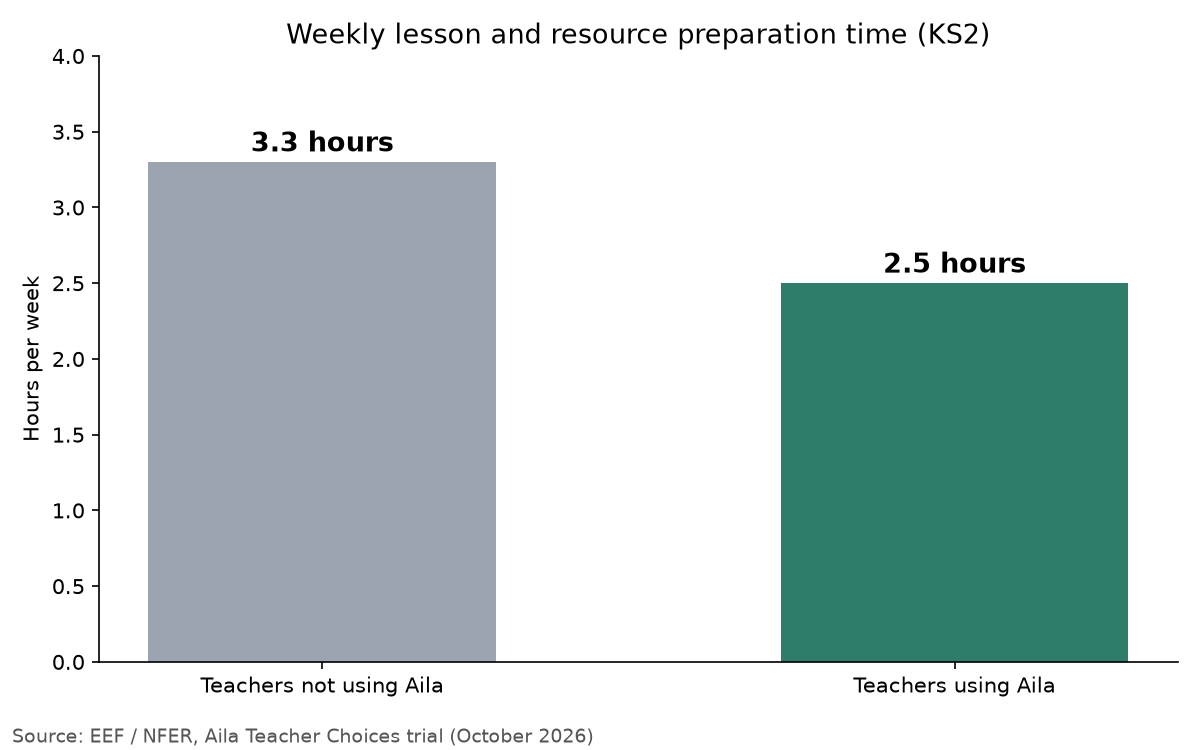
According to the NFER summary of the findings, teachers in the non-Aila group spent 3.3 hours a week preparing lessons and resources. The Aila group spent around 2.5 hours. That is a saving of 48.6 minutes a week on average, or 76% of the comparison group’s time. The EEF rounds this to a quarter less planning time.
Crucially, the quality of the lesson resources in the Aila group was no worse than in the comparison group. Quality is the first thing I would worry about with any shortcut, so that finding carries weight. The EEF gave the result a “high” security rating, which means a high degree of confidence in it.
Forty-nine minutes a week does not sound dramatic. Over a half term, though, it is most of a working day. For a teacher who plans on Sunday afternoons, it could be the difference between finishing before tea and finishing after it.
Who benefited, and who didn’t
This is the part I would want every school leader to read. The savings were not spread evenly. Teachers who were new to the profession, had lower confidence in their subject knowledge or lower pedagogical knowledge, or were more confident with technology were more likely to see their workload fall.
That makes complete sense to me. Picture an early career teacher in Year 5 who has been handed a science unit on forces and has never taught it. A tool that proposes a curriculum-linked objective and a sequence of activities gives them a scaffold to work from. Now picture a teacher with fifteen years in Year 3 who already has a folder of tried and tested Romans lessons. Starting from a blank page is the last thing they need. They want to tweak what already works.
The EEF press release says as much: some teachers found Aila accessible and useful for unfamiliar topics, while more experienced colleagues preferred to adapt existing plans. NFER also notes a perception that Aila’s outputs often needed adapting before they were ready for the classroom.
The drop-off problem
Here is the finding that I think deserves the most attention. Use of Aila fell over the ten weeks. On average it was used for only 7% of lessons, and 81% of the Aila group used it at least once. In a post-trial survey, fewer than one in five teachers felt the tool had meaningfully influenced their teaching and planning.
This echoes an earlier EEF trial, published in December 2024, which looked at teachers using ChatGPT for lesson planning. Those teachers spent 69% of the time of a comparison group planning without AI, and their use also declined across ten weeks.
So two well-designed trials now point the same way. AI can save planning time without harming quality, yet teachers do not keep using it. Professor Becky Francis, the EEF’s chief executive, put it plainly in the EEF press release, describing AI as far from a “silver bullet” for workload and noting that “just providing tools does not lead to sustained adoption.”
I don’t read the drop-off as teachers being stubborn. Planning is a habit built over years, tied to schemes of work, shared drives and conversations with the colleague next door. A new tool has to fit into that, not sit beside it. Remember too that the comparison group could use other AI tools, and NFER reports that many teachers preferred alternatives they found easier to use. Some of the savings question is really about which tool, not whether to use one at all.
What I would do with this as a school
My view is simple. Stop treating AI planning tools as a whole-staff initiative and start treating them as targeted support. The EEF’s own guidance on the project page lands in the same place.
If I were a primary head, I would offer Aila or a similar tool first to early career teachers and to anyone teaching outside their specialism, such as a Year 6 teacher picking up computing for the first time. I would pair it with a mentor who checks the output, because Dr Ben Styles of NFER raises a fair concern: substituting for experience could help, or it could risk poorer lessons.
A tool that writes a confident lesson plan does not guarantee a confident lesson.
For experienced staff, I would not push. I would ask what part of their planning is genuinely tedious. Often it is differentiating a worksheet three ways or writing retrieval questions, not designing the lesson itself. That is where a quick AI task might earn its place. Our earlier list of practical ways teachers can use AI has more ideas along those lines, and our round-up of free digital tools for everyday teaching tasks covers some of the non-AI options too.
Whatever tool you choose, check how it handles data and whether your school has approved it. We looked at the wider questions in the ethical implications of AI in education, and they apply here as much as anywhere.
Where this leaves us
The Aila trial is good news, but it is modest good news. A free, curriculum-aligned tool saved teachers time without lowering quality, and that is a genuine result. It also showed that time saved in a trial does not automatically become a lasting change in how people work.
Oak’s chief executive, John Roberts, says new tools are coming soon, and the EEF is funding further research into how generative AI affects learning. I’ll be watching for the next step NFER mentions: whether a new teacher planning with AI actually teaches a better lesson. For now, the honest answer to “should I use AI to plan?” is that it depends on who you are and what you are planning.
Frequently asked questions
Is Aila free?
Yes. Oak National Academy says Aila is completely free to use, like all of its resources, although fair use limits apply if use appears excessive. Teachers need to create an Oak account to access it.
Does AI lesson planning save time?
In the EEF trial, KS2 teachers using Aila spent around 2.5 hours a week on lesson and resource preparation, compared with 3.3 hours for teachers not using it. That is an average saving of about 49 minutes a week.
Did using Aila lower the quality of lessons?
No. The evaluation found that lesson resources from the Aila group were no worse in quality than those from the comparison group.
Which teachers benefited most from Aila?
Teachers new to the profession, those with lower confidence in their subject or pedagogical knowledge, and those more confident with technology were more likely to see their planning workload fall.
Over to you. Have you tried Aila or another AI tool for planning, and did you keep using it after the first few weeks? Tell us in the comments what stuck and what didn’t.