A practical routine for syllabus-aligned questions, review and mastery
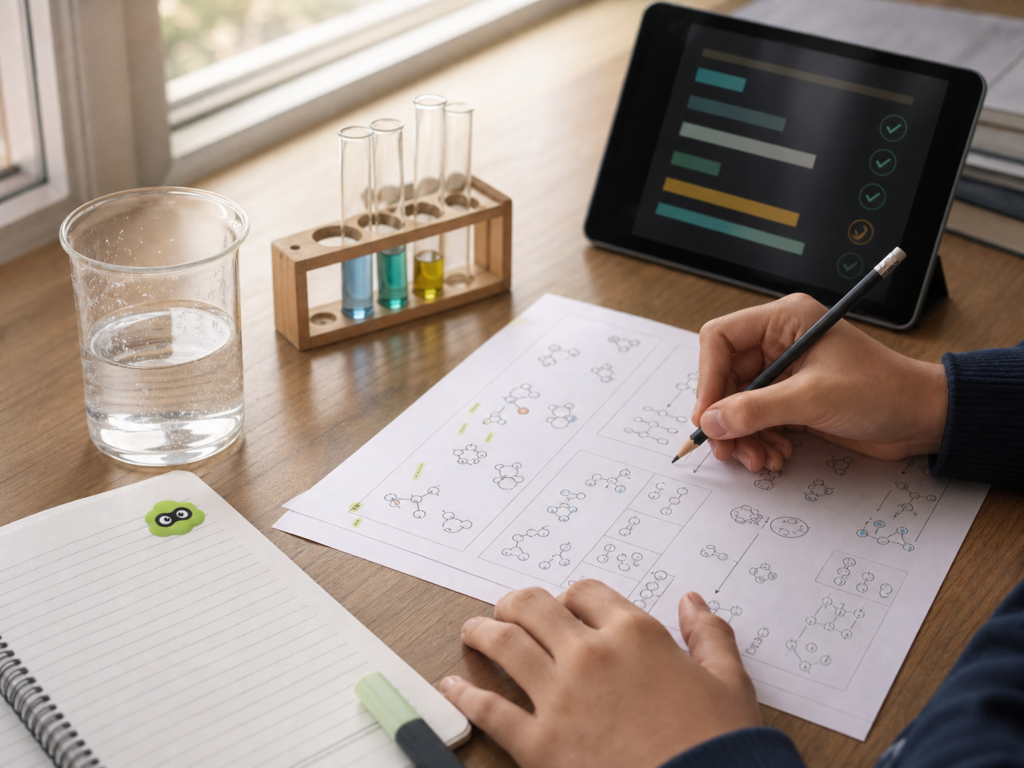
IGCSE Chemistry revision can become busy without becoming useful. A student may complete a worksheet, watch an explanation and then move on, yet still make the same mistake in the next test. The issue is often not motivation or a shortage of information. It is that practice is not connected clearly enough to the syllabus objective the student is trying to master.
A more reliable routine starts with one defined objective, uses a short set of carefully related questions, and ends with a review of what changed. This approach helps students practise independently while giving teachers a clearer view of where support is needed. It also works across other international curricula because the underlying principle is the same: learning becomes easier to manage when the course is broken down into visible, achievable steps.
Why chemistry practice can feel harder than it needs to be
Chemistry combines several kinds of thinking. Students may need to remember facts, interpret particle diagrams, apply a calculation, explain a trend and use precise scientific language in the same unit. A mixed worksheet can show that a student is losing marks, but it may not show which of these skills is causing the problem.
For example, a student who struggles with bonding may not have one single weakness. They may understand that atoms form bonds, but confuse the structure of an ionic compound with the structure of a simple molecule. They may identify a substance correctly but fail to connect its structure to its melting point or electrical conductivity. Treating all of these errors as one general problem makes the next revision session difficult to plan.
Step 1: Begin with one syllabus objective
The first step is to replace a broad instruction such as “revise Chemistry” with a specific target. Depending on the course, the target might be explaining ionic, covalent and metallic bonding; calculating moles from a balanced equation; interpreting rates of reaction; or describing how acids react with bases. The objective should be narrow enough that a student can tell whether it has improved by the end of the session.
This is where a syllabus-aligned Question Bank can be useful. Instead of searching through unrelated worksheets, the student can move directly to a course, subject, topic and learning objective. The purpose is not to produce the largest possible list of questions. It is to create a practice set that tests one idea from several angles.
Step 2: Use a short set with purposeful variation
A good practice set does not repeat the same question with only the numbers changed. It keeps the objective stable while varying the representation, wording or context. A bonding set might begin with identifying the type of structure, move to a particle-level diagram, and finish by asking the student to explain a physical property. A mole calculation set might progress from a direct calculation to a question requiring unit conversion and then to an unfamiliar reaction context.
The number of questions matters less than the feedback they create. A short set can be enough if it helps the student answer three useful questions: What did I understand? Where did my method break down? Can I apply the same idea when the question looks different?
Step 3: Review the first incorrect step
After answering, students should review the first incorrect step rather than looking only at the final score. In Chemistry, the first error may be a misread command word, an incorrect formula, a missing unit, an assumption about particles or a failure to link evidence to a conclusion. Finding that point makes the next action more specific.
A connected study workflow can support this process. A student might move from the Question Bank to a short Concept explanation, check a supporting Document, and then return to another question on the same objective. The important part is that these resources are connected to the same learning target instead of being separate tabs that the student has to organise alone.
Step 4: Turn practice into visible mastery
Progress should be more informative than a percentage after one worksheet. Students need to see whether an objective is becoming secure across several attempts. A mastery view can help them distinguish between a topic they have not studied yet, a topic they understand but cannot apply consistently, and a topic where only exam communication needs work.
This also changes the student’s role. Instead of waiting for a teacher to tell them what to revise, they can identify a weak objective, complete a focused practice set, review the error and check progress again. Teachers benefit too: the next lesson or intervention can be based on a visible pattern rather than a guess from one test score.
Where AI fits into the process
AI can explain a Chemistry idea quickly, generate examples or help a student ask a better question. Those uses can be valuable, but an explanation alone does not show whether the student can apply the syllabus objective independently. The practice system still needs accurate course mapping, carefully selected questions and a way to record progress over time.
That is why a structured platform can complement AI rather than compete with it. When questions are aligned to the intended course and broken down into manageable learning objectives, students can use AI for clarification while using practice and mastery data to decide what to do next.
A repeatable routine for independent revision
A practical IGCSE Chemistry session can be simple: choose one objective, complete a short varied set, mark the work, identify the first incorrect step, review the related concept and try one or two new questions. Repeat the cycle later in the week to check whether the improvement lasts.
This routine is useful for teachers setting homework, students revising independently and families trying to understand why revision time is not always producing progress. It can also be adapted for Biology, Physics, Mathematics and other international courses because it focuses on the learning process rather than one specific subject.
The goal is not to make students complete more material for its own sake. It is to make each practice session answer a clear question about learning. When the syllabus, questions, concepts and progress record work together, students can spend less time guessing what to revise and more time improving the exact skill they need next.
About the author
Henry Yang is part of the EduNinja team, an education platform supporting students across IGCSE, A-Level, IB and AP courses. EduNinja combines syllabus-aligned practice, concept support, documents and mastery tracking so students can work on specific learning objectives and see their progress over time.