Decksy surveyed 1,036 current full-time and part-time teachers in the United States to examine the hidden workload behind presentation prep and the role of AI models in streamlining it. The survey revealed that 71% of educators prepare lesson presentations outside scheduled working hours at least sometimes.
Below, we analyze the full results of the survey. We examine how teachers spend their time preparing for classes, how they develop teaching materials, how artificial intelligence tools help them save time, and what they would do if two additional hours were added to their schedule.
Key Insights on Lesson Planning
- 70% create or significantly update at least three lesson presentations in a typical week.
- 58% said that planning the structure of a lesson was one of the most time-consuming tasks.
- 82% of AI users save at least one hour per week, while 37% save 3 hours or more.
- 41% would not trust Artificial Intelligence with factual accuracy without their own final review.
- 43% said that if AI tools gave back two hours a week, they would spend them on better individual attention to students.
Lesson Presentations Are a Recurring Workload
For many educators, making a presentation is not a task reserved for the start of a unit. 70% of respondents create or substantially update at least three lesson presentations in a typical week, while 14% work on eleven or more.
The time required adds up. About half of the teachers surveyed spend at least an hour preparing a single presentation. That time accumulates before other resources are considered.
Preparation Often Extends Beyond Working Hours
According to the survey, 71% of the teachers engaged in preparations for lessons beyond working hours sometimes or even often. Only 22% of the respondents claimed to do all this work during regular working hours.
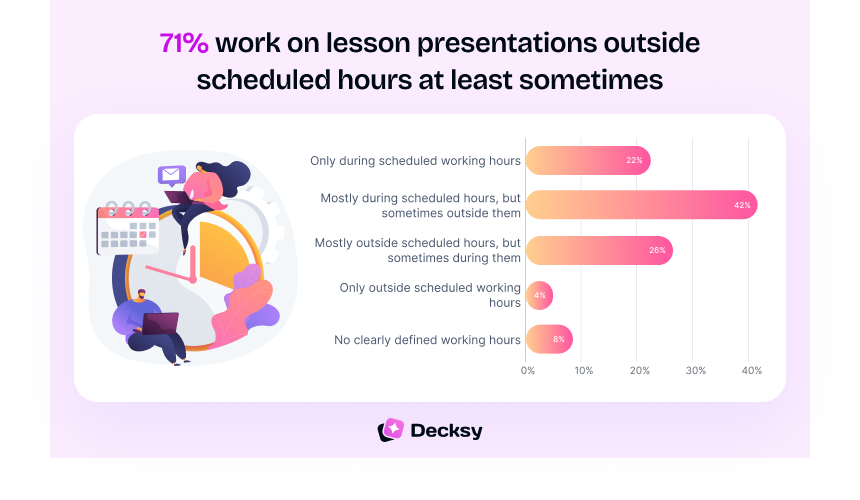
It does not imply that all teachers do preparations in the evening. The majority of 42% do it mostly within working hours but sometimes prepare slides for the next day.
The issue is important even if it happens only sometimes since it is becoming the habit of teachers. In order to decrease teachers’ workload, it should be taken into account.
Structuring a Lesson Takes More Time Than Designing Slides
It may be natural to assume that design elements such as layouts, fonts, and pictures take up the most time. However, this is not what teachers’ responses reveal.
58% mentioned that organizing the sequence of the lesson was one of the most time-consuming activities when creating a presentation. Content creation followed closely with 56%.
This requires a teacher to arrange concepts in a certain order, determine the prerequisite knowledge required and add examples and tests.
Although a professional template helps increase consistency, it does not replace a teacher making these decisions.
The Work Continues After the Slides Are Finished
According to the survey, 59% of educators create worksheets after developing their slides. Other educators create handouts (46%), quiz/exam (44%), homework/follow up activity (33%), and speakers’ notes (32%).
69% of educators take an additional 30 minutes or more to create such materials.
It is easy to ignore such statistics since slides are a more noticeable part of work. But it’s different exercises, questions for assessment and follow up activities that can help students to practice and show their understanding of material.
For educators, efficient EdTech workflow would be linking presentations to such supporting materials rather than treating every item separately.
AI Saves Time, but Teachers Retain Responsibility
For teachers who utilized AI, 82% of them were able to save at least an hour a week. Over a third, 37%, claimed they saved three hours or more.
From this data, it seems that AI can be effective in preparation activities that take place every week. It might assist in outlining material, organizing content, creating exercises, or even in generating a preliminary lesson that teachers can polish.
But mere time-saving does not indicate whether the generated lesson is factually correct, age-appropriate, or relevant to educational goals. These are questions for professionals.
The Accuracy Question Remains Unresolved
One of the most evident barriers to AI implementation is that of trust. 41% of participants stated that they would not trust the accuracy of information provided by AI without reviewing the output manually. Only 12% of them stated that they would trust it unconditionally.
It is worth noting that 54% of teachers who implemented AI in their practice admitted that they used AI as a means of checking the accuracy of lesson materials. Such a statement does not mean that AI is a reliable source of truth.
For teachers, it can be recommended to implement AI for creating a first draft and then independently verify the accuracy of facts, references, examples, and the overall educational utility of materials.
What Would Teachers Do With Two Extra Hours?
When asked how they would use two hours saved through AI-assisted preparation, 43% chose spending more time giving students individual attention.
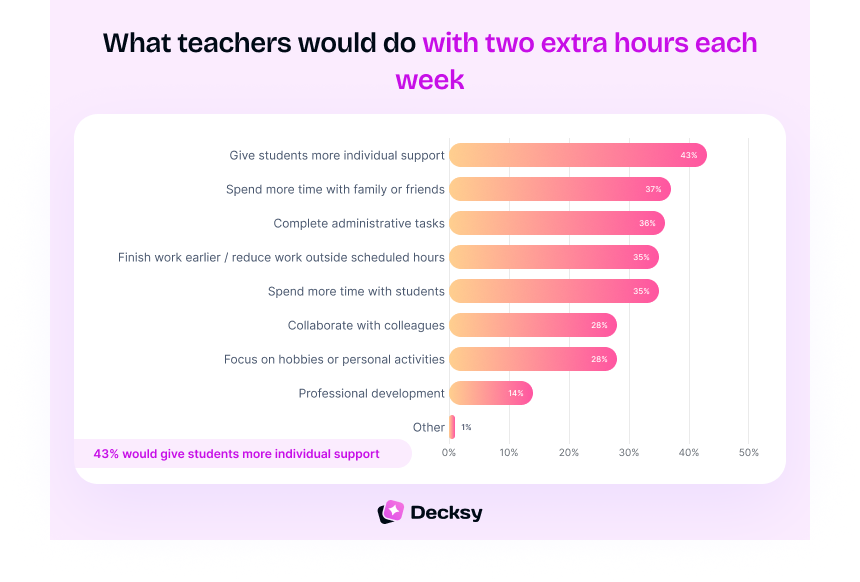
That response reframes the value of faster slide creation. One-to-one explanations, targeted feedback, and support for struggling learners are not easily replaced by automation.
Others might finish administrative work or reclaim personal time.
The Bottom Line
The easiest part of lesson planning to see is the presentation on the screen.
The survey reflects all of this behind it: organization, information, graphics, fact-checking, adaptation, exercises, tests, and additional time that preparation takes beyond class hours.
Artificial intelligence tools are already helping to lighten some of this workload. However, the role of teachers does not seem to be to allow technology to take complete control of the learning process. Instead, they use technology to accelerate certain aspects of the learning process while maintaining control over its accuracy and quality.
Methodology
Decksy surveyed 1,036 full-time and part-time U.S. teachers aged 23–65 through online panels using Random Device Engagement (RDE). Percentages were rounded to whole numbers, with multiple selections possible for applicable questions.
Author Bio
On decksyai.com, where clarity still matters, but results matter just as much, Alyssa Johnson, Chief Revenue Officer, looks at messaging through a growth lens. She pays attention to how structure drives action, how a well-timed pause improves conversion, and how AI is reshaping all of it, without ever replacing the human instinct behind the message.