Ask a room of teachers what AI is actually good for and someone will say quizzes within a minute. The learning scientists agree, with a catch. A new expert consensus report from the University of Minnesota suggests that AI retrieval practice, where a chatbot quizzes students on material they have already been taught, is one of the most useful jobs we can give it. Ask the same chatbot to do the remembering for them and the picture flips.
In short: 30 learning experts rated how generative AI is likely to affect 65 learning processes. They agreed it should strengthen practice, feedback and self-testing, but is likely to weaken first-time learning, recall, writing and critical thinking. The working rule for classrooms is simple. Teach it first without AI, practise it with AI, then apply it without leaning on AI.
What the University of Minnesota report did
Released in early October 2026 by the university’s College of Education and Human Development, Ways Generative AI Can Support and Threaten Learning in K-20 US Education was led by Panayiota Kendeou, Jeffrey Greene and Nia Nixon. Thirty specialists in cognitive science, educational psychology and the learning sciences first nominated the learning processes they thought AI could affect. These were boiled down to 65 processes, from encoding to sense of belonging, and the panel rated each for how likely AI was to enhance or disrupt it. The method was preregistered, and the percentages are out of the 28 experts who submitted ratings.
A process counted as reaching consensus when its average score was at least 3 out of 5 and at least 75% of the experts scored it 3 or higher. Forty-two of the 65 processes cleared that bar for enhancement, disruption or both.
This is not a trial, and nobody measured pupils’ test scores. It is the considered judgement of people who study memory and learning for a living, at a time when, as Kendeou told her department’s news team, “we don’t have good evidence” from studies of AI itself. I find that more useful than another survey of how students feel about chatbots.
Why AI retrieval practice sits in the sweet spot
The authors call their central finding the GenAI Paradox. AI looks risky at both ends of learning and helpful in the middle. When students first meet new material, handing the work to a chatbot threatens the effort that gets ideas into memory. When they later use those ideas in new situations, it threatens the higher-order thinking that makes understanding deep. In between, when students are strengthening what they have just learned, the experts think it can genuinely help.
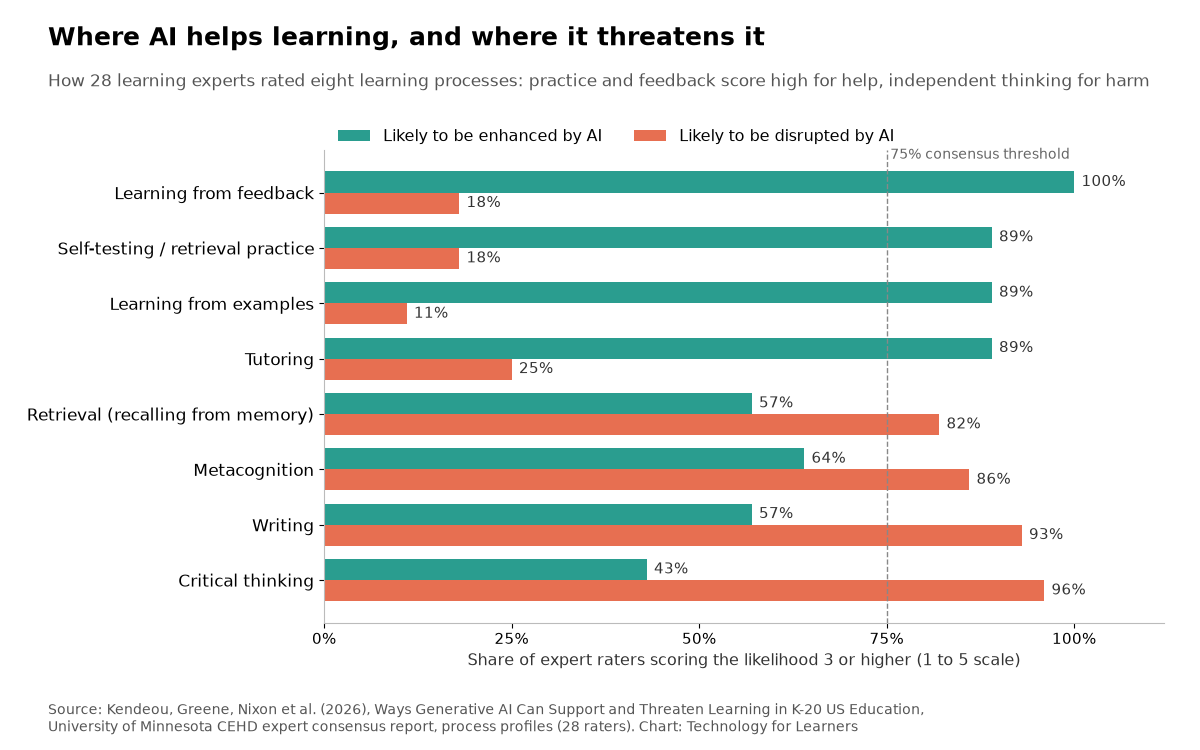
The strongest enhancement ratings all sat in that middle zone. (Here, likely means a score of 3 or more out of 5.) Every rater thought AI was likely to enhance learning from feedback. For self-testing and retrieval practice, learning from examples and tutoring, the figure was 89%. Concern about disruption for those same processes was low, between 11% and 25%.
Retrieval and retrieval practice are not the same thing
This is the detail I would put in front of every staffroom. The experts rated retrieval itself, the act of pulling something out of long-term memory, as vulnerable: 82% thought AI was likely to disrupt it. Yet self-testing and retrieval practice came out as one of the clearest wins. That sounds like a contradiction until you ask who is doing the remembering.
If a Year 9 student types “what were the causes of the Russian Revolution?” the bot retrieves and the student reads. Nothing in the student’s memory gets stronger. If the same student asks the bot to quiz them on the causes, one question at a time, holding back the answer until they have had a go, the student does the retrieving and the bot supplies the questions and the feedback. The report notes that AI “can produce tailored content that can be used for self-testing”, and warns of risks to retrieval when it is “not practiced”. Same tool, opposite effect.
Let the chatbot ask the questions. Make sure the student is the one answering them.
What this looks like in a real classroom
First contact: teach it without the chatbot
For new content the report is blunt: people should “initially learn without GenAI assistance”. The explanation, modelling and first worked examples come from you and the textbook. A Year 7 class meeting particle theory for the first time does not need a chatbot summary. It needs a clear explanation, a demonstration with a balloon and a bottle, and questions that make them think.
Consolidation: AI as quizmaster and feedback partner
This is where AI earns its place. Here are two prompts I would happily give a Year 10 class for revision homework:
- “Here are my notes on photosynthesis. Ask me ten questions, one at a time. Wait for my answer before telling me if I’m right, and explain any mistake in two sentences.”
- “Show me two worked examples of this type of equation, then give me a third to try on my own. Don’t show the answer until I’ve attempted it.”
Both keep the student doing the thinking. Teachers can use AI the same way, drafting low-stakes quizzes and spaced review questions for lesson starters, which is one of our practical ways teachers can use AI. Read the questions before they reach the class, though. The experts flagged that AI feedback “can be inaccurate or overly generic”.
Application: their thinking, not the bot’s
When students write an extended answer, plan an investigation or argue a case, the panel’s concern peaks. Critical thinking drew the highest average disruption score in the whole report, 4 out of 5. Some 96% of experts rated it likely to be disrupted, while only 43% saw potential for gains. Writing was the only subject-specific process to reach consensus at all, and that was for vulnerability, at 93%. So the essay plan, the hypothesis and the final judgement should belong to the student. If AI comes in, it comes in late, as a critic that spots a claim without evidence, never as the author.
Where the experts are most worried
Beyond writing, two findings stood out for me. The first is self-regulation. Some 93% of raters thought AI likely to disrupt self-regulated learning, and 86% said the same of metacognition. Those are the very skills students need to use AI sensibly.
The second is the social side of learning. Social connection, collaborative learning, socio-emotional development and sense of belonging all reached consensus for disruption with no clear route to enhancement. Age matters here too. The experts judged younger pupils more vulnerable and state plainly that students “must be able to learn independently before using GenAI”. That chimes with the Australian advice on primary pupils that we unpacked in our piece on cognitive offloading and AI.
What school leaders can do this half term
The panel also rated 11 recommendations. Those scoring well on both impact and realism were using AI to widen brainstorming after students have shared their own ideas, adaptive scaffolding such as hints and feedback, and teaching AI literacy, including how to fact-check outputs. Gating AI access until students show core competence, and redesigning assessment, were judged valuable but hard to implement.
I would start smaller than a policy rewrite:
- Add one line to your AI guidance: AI may quiz, hint and give feedback, but it does not do the first learning or the final thinking.
- Share a short bank of retrieval prompts with staff and students so that the default use is the useful one.
- Keep regular retrieval slots with no devices at all, such as mini whiteboards or a two-minute brain dump, so you can see what has actually stuck. Our round-up of Hattie strategies that work in the classroom covers spaced practice.
A word of caution about the evidence
The report is honest about its limits. For most of the 42 consensus processes, the experts rated the evidence on AI’s effects as thin. For self-testing, only 18% judged it moderate or strong. The authors call this gap “the most important meta-finding of the report”. Their ratings are also about students using general chatbots on their own, not tools a teacher has configured. Treat it as a well-informed map rather than a verdict, and let your students’ unaided work tell you whether it holds.
Frequently asked questions
What is AI retrieval practice?
AI retrieval practice means using a chatbot to quiz students on material they have already been taught, so that they recall the answers themselves. The AI writes the questions and gives feedback, while the student does the remembering.
What is the GenAI Paradox?
It is the University of Minnesota report’s name for its main finding. Generative AI threatens first-time learning and higher-order thinking, but experts think it can strengthen the middle stage, when students practise and consolidate what they already know.
Does the report say students should not use AI for writing?
Writing was the only subject-specific process the experts agreed on, and 93% rated it as likely to be disrupted by AI. Some experts saw value in AI as a writing coach that points out weak evidence, but they warned against using it to produce polished work for students.
How strong is the evidence behind these findings?
The report is expert judgement, not a classroom trial. The experts rated the research on AI’s effects as thin for most learning processes, and the authors call for more rigorous long-term studies.
Has AI quizzing found a place in your classroom yet, and how do you stop it sliding into AI answering? I would love to hear what has worked for you in the comments.