A Year 10 student hands in a beautifully structured essay on the causes of the First World War. Two weeks later, in a timed assessment, the same student can barely get past the opening paragraph. Most of us have seen some version of that gap by now. This week Australia’s national education research body gave it a name and a warning. Its new advice on AI in schools centres on cognitive offloading, the habit of letting a tool do the thinking that learning depends on, and it is the clearest evidence-based guidance on the subject I have read this year.
The short version: AI can make students’ work look better while they learn less. The Australian Education Research Organisation (AERO) says AI should support thinking, never replace it, and urges extra caution with younger pupils.
What AERO published and why it matters outside Australia
On 14 October 2026, AERO released two explainers: AI in schools: considerations for school leaders and teachers and a companion piece for policymakers. Both are free, and expert reviewers included Professor John Sweller, the psychologist behind cognitive load theory. The full teachers’ explainer (PDF) and the policymakers’ explainer (PDF) are both worth reading in full.
AERO is funded jointly by Australia’s federal, state and territory governments, and its starting point is refreshingly honest. There is very little rigorous research on AI and learning in schools, so AERO goes back to what we already know about how students learn and asks whether a given use of AI helps or hinders that process.
That framing travels well. If you teach in England, the Department for Education’s generative AI product safety standards already tell edtech suppliers to “make every effort to mitigate the potential for cognitive deskilling”. AERO’s explainers turn the same worry into something a classroom teacher can act on.
Cognitive offloading: when help stops helping
Cognitive offloading simply means handing mental work to something outside your head. We do it all the time, and it is not always bad. AERO’s own example is the calculator: if a student is learning to model a physics problem, letting a calculator handle the long multiplication frees up working memory for the part that matters.
The trouble starts when the thing being offloaded is the learning itself. Learning, in AERO’s model, is a change in long-term memory, and that change only happens when students do the effortful work of retrieving, connecting and practising. When a chatbot produces the answer, the explanation or the paragraph on demand, that effort quietly disappears.
AERO’s chief executive, Dr Jenny Donovan, put it bluntly in an interview with ABC News: “It’s when you rely on the tool to do the thinking for you, and there are real risks for students because they are novice learners.” The explainer calls the result a performance paradox, where students do better on a task with AI but learn less in the process.
The question is not whether the work got better. It is whether the student did.
The study every teacher should know about
Much of AERO’s argument rests on one of the few large experiments we have. Hamsa Bastani and colleagues gave nearly 1,000 high school maths students access to GPT-4 during practice sessions, then tested everyone in an exam without it. One group used a standard chatbot. Another used a version with prompts designed to give hints rather than answers. The results were published in PNAS.
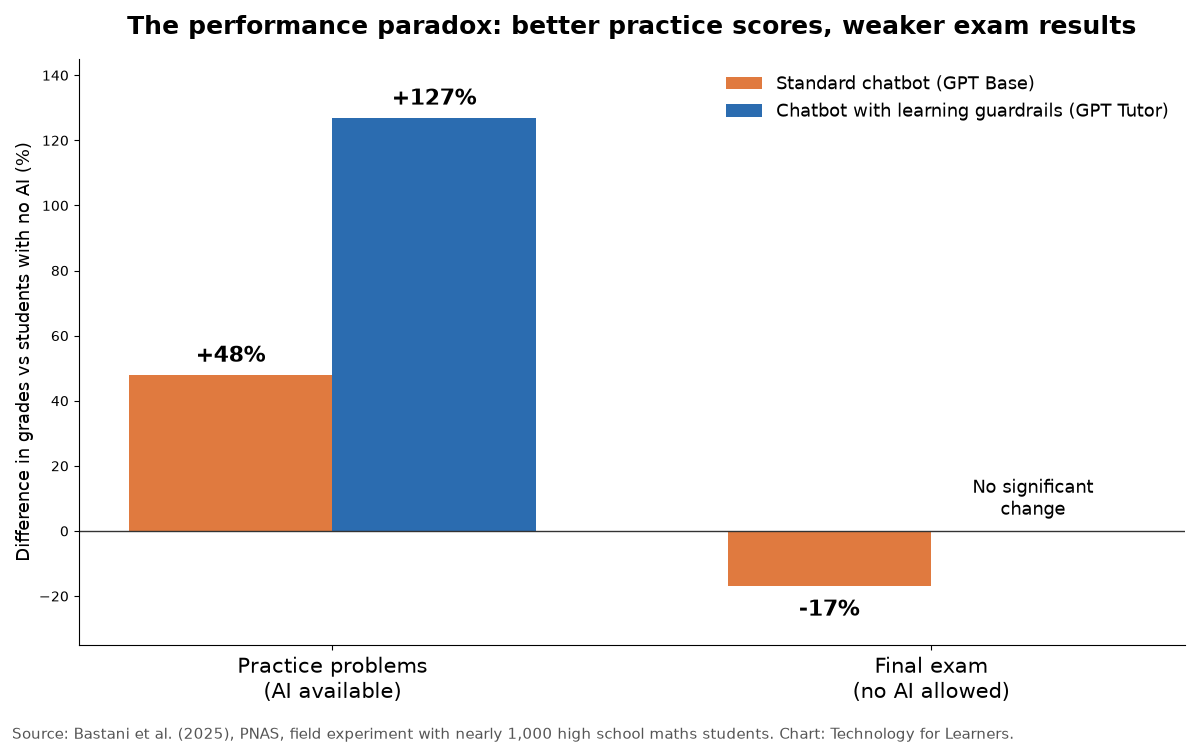
With the standard chatbot, practice grades rose by 48%. In the exam, those same students scored 17% lower than classmates who had never had AI at all. The guarded version produced an even bigger jump in practice, and the exam penalty essentially vanished, although it did not produce a gain either. The researchers found that students in the standard group often asked for solutions and copied them. Just as worrying, the students did not perceive that they had learned any less.
A second study cited by AERO, an experiment with more than 400 secondary students published in Computers and Education, found that students who relied on AI to work through a text had poorer comprehension and retention than those who took notes or combined AI with note-taking.
Keep the size of the evidence base in mind, though. Stanford’s SCALE Initiative reviewed more than 800 papers on AI in schools and found only 20 high-quality studies that could show cause and effect. Its full 2026 review reaches a similar conclusion to AERO: tools that scaffold reasoning look more promising than general chatbots that hand out answers.
What this looks like in a real classroom
Homework and independent practice
Picture a Year 8 class practising simultaneous equations at home. A student who pastes each question into a chatbot will return a perfect sheet and a false sense of security. AERO’s distinction is useful here. Using AI to generate an extra worked example supports learning. Using it to supply the answer to the problem bypasses it. If your school allows AI for homework, say which of those two you mean, in writing, and show students what each looks like.
Writing
The same line runs through extended writing. AERO suggests that AI editing an essay a student has drafted can support learning, while AI writing the whole essay cannot. With younger secondary students I would go further and ask for their own plan and first paragraph before any tool touches the work. That keeps the hard thinking with the student and gives you something to compare the final piece against.
Primary pupils
The explainer says schools should take greater care with AI before secondary school, including thinking about age restrictions and closer teacher oversight. Dr Donovan went further in her ABC interview, saying AI should be avoided completely in the first three years of primary school. Whether or not you go that far, the reasoning holds. Young children are still building the background knowledge they would need to spot when a chatbot is wrong, and a Year 2 pupil cannot fact-check something they have never learned.
Assessment needs a rethink, not a detector
AERO is frank that teachers cannot reliably tell whether AI was used in take-home or unsupervised online tasks. It points to a New South Wales survey by Learning First in which only 21% of teachers said their school had given them direction on assessment, and about half worried about not knowing how to prevent AI use. Many were moving towards handwritten work in class, collecting evidence of the process, student declarations and short oral defences of their work.
The explainer also asks schools to think hard before using AI detection tools, given their biases and their potential to disadvantage students with English as an additional language. A ten-minute conversation about a piece of coursework tells you more than any detector score.
There is a more hopeful side. Some AI tools let teachers see students’ conversations with the tool, and AERO suggests these logs can reveal misconceptions you would never spot in a finished product. Used that way, AI becomes a window into thinking rather than a replacement for it.
What I would change on Monday
None of this needs a new policy document first. If I were leading a department this half term, I would start here:
- Agree a simple departmental rule for each task: AI allowed to check, AI allowed to explain, or no AI. Put it on the task sheet.
- Build more low-stakes retrieval practice without devices, so students and teachers can see what has actually stuck.
- Where AI is used, prefer tools or prompts that ask questions and give hints. A starter prompt that tells the chatbot not to give the final answer is a quick win.
- Teach students to ask themselves, before they open a chatbot, whether they are trying to finish the task or learn from it.
That last habit is really metacognition, and it is worth teaching explicitly. If you want a framework for talking to students about depth of understanding, our guide to the SOLO taxonomy works well alongside this. For teacher-facing uses of AI, where the risk to pupils’ learning is lower, our list of practical ways teachers can use AI is a good starting point, and our look at what the Aila trial found about AI lesson planning shows how much time those tools can genuinely save.
AERO is careful to call its guidance provisional, and it promises updates as better research arrives. That is the right tone. We do not need to ban AI from secondary classrooms, and we should not hand it to every seven-year-old either. What we need is the discipline to ask, for each task, who is doing the thinking.
Frequently asked questions
What is cognitive offloading?
Cognitive offloading means handing mental work to an external tool. It can help, as when a calculator frees up working memory, but AERO warns it becomes harmful when students use AI to do the thinking needed to build knowledge in long-term memory.
What is the AI performance paradox?
It describes students performing better on a task while using AI but learning less in the process. In one maths experiment, students with a standard chatbot scored 48% higher in practice but 17% lower in a later exam without AI.
Does AERO say primary schools should not use AI?
The written explainer advises greater caution before secondary school, including considering age restrictions and closer teacher oversight. AERO’s chief executive told ABC News that AI should be avoided completely in the first three years of primary school.
Can teachers use AI for feedback and marking?
AERO says AI can help draft feedback statements where school policy and privacy rules allow, but teachers should review and tailor them and keep responsibility for interpreting student work and making assessment judgements.
Over to you. Where do you draw the line between AI helping a student and AI doing the work for them, and has your school written that line down yet? Tell us in the comments.